Most families spend more time researching a new stroller than they do vetting the person who will spend forty hours a week with their child. I have placed caregivers across Manhattan for years, and the mistake I see most often is parents treating the hiring process like a job interview for an office role. It is not. The stakes are different, and the screening needs to reflect that.
What should I actually check before hiring anyone?
Start with the basics, and do not skip them even when a candidate comes with a glowing personal referral. A criminal background check is non-negotiable — and it should cover all states the candidate has lived in, not just New York. A candidate who moved here from Ohio three years ago has a history that a New York-only check will miss entirely.
Beyond criminal records, you want a driving record check if they will ever be behind the wheel with your child, and a sex offender registry search. These are separate databases. Many parents assume a standard background check covers everything. It does not.
At NYC Nanny Care, we run checks through a professional screening service before any candidate meets a family. But even if you are searching independently, services like Sterling or Checkr can run a multi-state check for under fifty dollars. There is no good reason to skip it.
How do I check references without it feeling like a formality?
Written references are nearly useless. Anyone can hand you a glowing letter, and most people do. What you want is a real phone conversation with a former employer — ideally someone the candidate worked for within the last two years, caring for children in a similar age range to yours.
Ask open-ended questions. Ask how the candidate handled a difficult day, or what they would do differently if they could. Ask whether the family would rehire them. That last one is telling. A pause before the answer, or a careful pivot to talking about circumstances changing, says more than a yes.
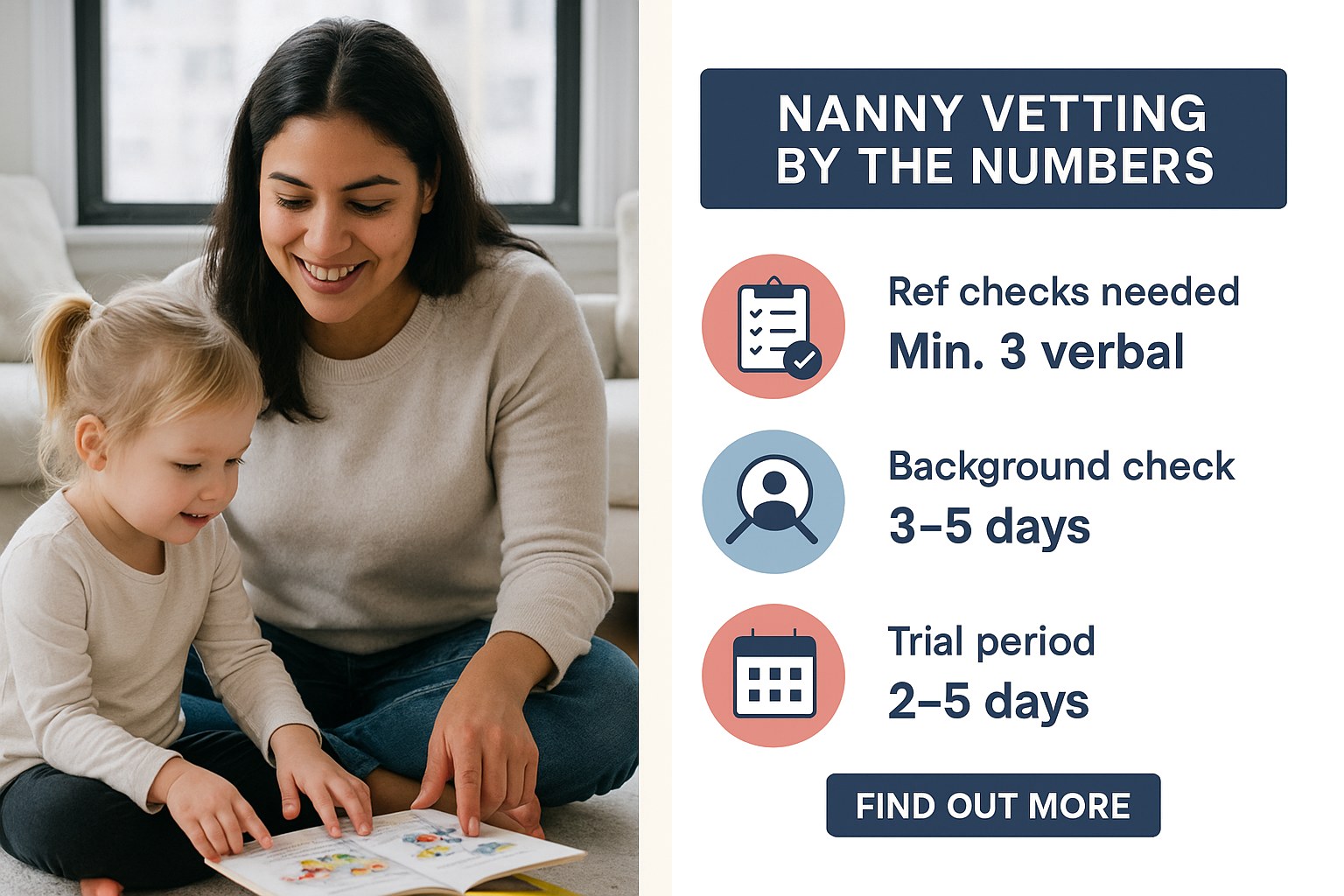
Three verbal references is a reasonable minimum. If a candidate struggles to provide three, that is worth understanding before you go further. Good candidates who have worked steadily almost always have more than three people willing to vouch for them directly.
Does it matter whether they have certifications like CPR?
Yes, and more than most parents realize until they need it. A CPR certified nanny in NYC is not a luxury or a box to tick — it is the difference between someone who can act in the first two minutes of a choking incident and someone who cannot. Pediatric first aid training matters equally. Children choke on grapes and small toys, not just in emergencies that feel dramatic and obvious.
Certifications should be current, not expired. CPR certification typically needs renewal every two years. Ask to see the card, and check the date. If a candidate says their certification lapsed but they remember the training, that is not the same thing.
Any serious nanny care service in New York should be verifying this before placement. If they are not, ask why.
What does a paid trial actually tell me?
More than any interview. An interview tells you how someone presents themselves. A trial tells you how they actually are with your child.
A good trial runs two to five days, with you present for at least part of it — especially the first day. Watch how they get down to a toddler's level. Watch whether they check their phone. Watch what they do in the first ten seconds when your child is upset. Do they move toward the child or wait to see what you do?
Pay for the trial at the same rate you would pay for the role. Expecting someone to work unpaid so you can evaluate them is not fair, and it also signals to good candidates that you may not be easy to work for. The best caregivers have options. They notice how you treat them from day one.
What do most parents forget to ask about?
Scheduling edge cases. What happens when your child is sick and cannot go to school — can the nanny stay later? What is their policy if they are ill? Do they have backup childcare for their own children or family commitments that might pull them out on short notice?
Also: their approach to screens, to discipline, to food. Not because there is one right answer, but because misalignment on these things causes friction fast. A nanny who believes firmly that a two-year-old should have no screen time and a family who uses an iPad as a daily tool are going to have a hard time, no matter how good the candidate is on paper.
Families I work with through NYC Nanny Care fill out a detailed preferences form before we match them with anyone, partly for this reason. Fit matters as much as credentials.
The families who have the smoothest placements are the ones who were honest during the hiring process — about their hours, their expectations, and their household. Vetting goes both ways.
If you want to talk through your specific situation, send me an inquiry through the site. I reply personally, usually within a couple of hours.